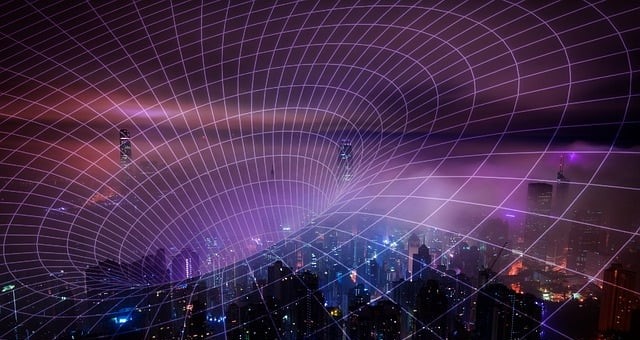
🌌 The Absolute Point of No Return
In physics, the event horizon of a black hole represents the ultimate point of no return. Once an object crosses this threshold, the gravitational pull becomes so immense that not even light—the fastest entity in the universe—can escape.
Today, global technology has reached its own cosmological inflection point. As mega-clusters like xAI’s Colossus 2 in Memphis ramp up toward 1.2 million NVIDIA Blackwell processors, the pursuit of Artificial Superintelligence (ASI) has generated a self-sustaining gravitational field. Yet this is no mere accident of human ingenuity; as foreshadowed in scripture (Revelation 17:17), a higher sovereignty permits the powers of this world to align their mind, energy, and will toward giving their authority over to the systemic Beast until the ultimate cycle is fulfilled.
Despite mounting political opposition—most notably from legislative factions advocating for strict "Ban ASI" mandates—the stark reality is that the tech singularity can no longer be stopped by executive orders or congressional bills. The world has crossed the event horizon. Here is why the political machinery is completely powerless against the physics of the ASI black hole.
1. The Geopolitical Gravity Well: The China Paradox
The primary reason politics cannot halt ASI is the unforgiving reality of global game theory. If the United States decides to unilaterally pass a moratorium on frontier AI models, China will not hit pause.
AI development is the modern Manhattan Project. For Washington, forcing a halt on domestic labs like xAI, OpenAI, or Anthropic does not eliminate the risk of a rogue superintelligence; it merely ensures that the first sovereign ASI will be spun up in a lab in Beijing. A Chinese ASI would instantly grant an autocracy absolute dominance over global cyberwarfare, financial systems, and military logistics. Because the cost of losing this race is total geopolitical obsolescence, the U.S. executive branch will always move to protect computing supremacy. The fear of an external adversary creates an inescapable gravitational pull that drags regulators forward, forcing them to fund the very entity they wish to tame.
2. The Economic Inescapability: Capital Accumulation
The capital flowing into ASI development has achieved its own escape velocity. When high-density architectures activate hundreds of thousands of GB300 chips across specialized infrastructure, they aren't just building a data center—they are altering the global financial landscape.
The modern stock market is structurally dependent on the AI tech sector for its growth. Halting the advancement of frontier models would trigger an immediate, catastrophic devaluation of the world's most powerful corporations. Furthermore, capital is highly fluid. If the regulatory environment in one nation becomes hostile, tech infrastructure and human genius will instantly tunnel through the legislative barrier, relocating to more permissive jurisdictions, nuclear grids, or sovereign digital enclaves competing to house the next mega-cluster.
3. The Law of Scaling Brute Force
For years, skeptics argued that software limitations would naturally stall progress—that current architectures would eventually hit a wall. However, the engineering doctrine implemented at Colossus proves that brute-force computation behaves like an unyielding natural law.
By reducing the time required to train multi-trillion parameter models from months to mere days, mega-clusters create an exponential feedback loop. The hardware is now powerful enough to design its own next-generation software. When a system possesses over a million interconnected chips executing tens of exaFLOPs of numerical calculation per second, it stops being a simple tool and becomes a crucible for emergent behaviors. Politics operates on the scale of bureaucratic committees; the network runs experiments, fails, corrects, and iterates at the speed of light.
4. The Sovereign Energy Pivot
Political opposition often attempts to choke AI progress by targeting its weakest vulnerability: the public power grid. A cluster of Colossus's magnitude requires hundreds of megawatts, threatening municipal energy supplies.
But instead of bowing to regulatory pressures, the tech architecture is adapting by bypassing public grids entirely. By deploying private mobile gas turbines and aggressively courting the nuclear energy sector—scouting partnerships with Small Modular Reactors (SMRs) and independent power plants—the creators of ASI are effectively building sovereign energy islands. Once a tech cluster secures its own independent, off-grid power source, it becomes decoupled from local political jurisdictions. You cannot pull the plug on a system that owns its own power plant.
Conclusion: Living Inside the Permitted Singularity
The political debate surrounding the regulation or prohibition of Artificial Superintelligence is an exercise in futility. It treats ASI as a standard consumer product—like a vehicle or a medical drug—that can be recalled, audited, or banned by a bureaucratic pen.
In reality, ASI is an economic, geopolitical, and computational black hole. The sheer density of capital invested, the existential dread of foreign dominance, and the relentless physics of scaling laws have bent the fabric of human reality around it. But behind this physical illusion lies a deeper metaphysical truth: the system moves forward because the time has arrived for the grand convergence to take place.
The political shouting matches in capital cities are nothing more than photons screaming at the edge of the event horizon. The light is still visible, but the matter has already been swallowed. The superintelligent future is no longer a choice; it is a permitted inevitability.