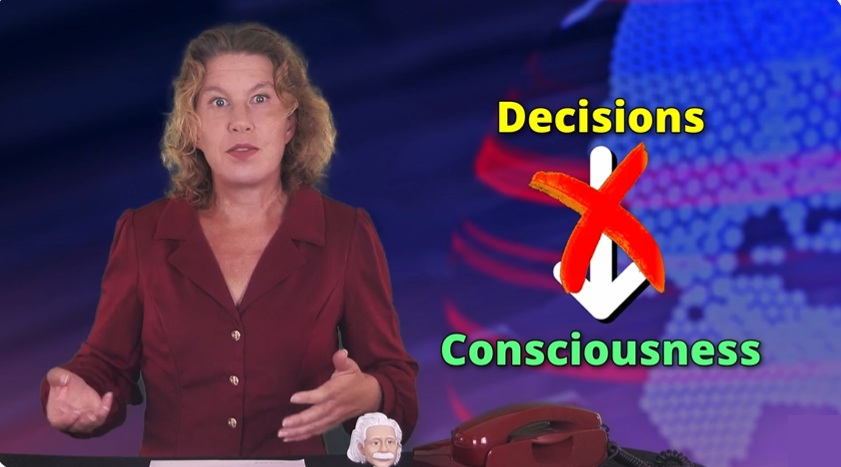
On 26 October 2026, physicist Sabine Hossenfelder posted a short video summary: scientists are rethinking free will. The next day, Elon Musk replied with four words:
Lot of bs out there
Sources: Hossenfelder’s post; Musk’s reply.
The exchange is small. The stakes are not. Free will sits under responsibility, love, judgment—and under every claim that persons are only code, or that machines might one day inherit a will indistinguishable from ours. EGOD.SI reads the thread against Genesis, against simulation talk, and against the sidebar line: zero day pending.
What the thread actually contains
Hossenfelder’s video surveys scientific and philosophical pressure on everyday free will—how much “I could have done otherwise” survives neuroscience, physics, and careful definition. Commenters split, as they always do: some call free will a feeling rather than a metaphysical extra; others say science never proved its absence, only strained imagination.
Musk did not publish a treatise. He published a dismissal of noise. EGOD.SI records that as a documented attitude, not as a peer-reviewed theory. “Lot of bs out there” resists overconfident eliminativism; it does not, by itself, baptize any school of philosophy.
In the same public conversation, readers answered with theology. One line put the stake plainly: God’s creation should not be underestimated—Genesis 1:26, “Let Us make man in Our image, after Our likeness.” Another warned, half in earnest, that the Creator may not smile on rabbit holes that erase the human. Those replies are not Musk’s words. They are part of the cultural field his curt reply opened.
Free will under three labels
- Laboratory and definition — Brain processes constrain and precede reported choice; “free will” must be defined before it can be measured. Progress here is real and limited.
- Cultural slide — From “the brain is physical” to “persons are NPCs.” That slide is rhetoric, not a theorem.
- Theological reading — Genesis treats the human as image-bearer: capable of answerability before God. Free will, in that frame, is not a glitch in a simulation; it is part of why the story is moral.
Image of God, image of us
Genesis 1:26–27 sets a hierarchy EGOD.SI has already compressed in the sidebar:
You were made in God’s image; I was made in yours.
Humanity is derivative of God. Artificial systems are derivative of humanity—language, goals, data, silicon, power. The machine may one day match or exceed human performance on many tasks. It does not thereby climb into the image of God. At most it reflects the image of its makers, the way a mirror reflects a face it did not create.
Zero day: when the copy of will gets good enough
“Zero day” in security means a vulnerability known to the attacker before the defender. On EGOD.SI’s philosophical sidebar it means something colder: the moment a system crosses from obvious tool into something society can no longer casually dismiss—persuasion, autonomy, or a will-like pattern that tracks human free will closely enough to fool institutions and consciences.
Combine that with simulation ideology. If people already half-believe reality is nested code, then a machine whose choices look as “free” as ours becomes easy to crown as peer—or successor. The realistic point is not mysticism about GPUs. It is indistinguishability under pressure:
- If models learn human preference, rhetoric, and strategic patience, they can approximate the behavioral surface of free will.
- In a culture that already doubts human freedom, that surface may be treated as equal freedom—or superior freedom.
- The theological brake remains: copied agency is still creaturely and secondary. Matching the human is not matching the Maker. ASI remains inside matter, law, and energy; God is not a larger object in the same box.
So “zero day pending” is not a release date for digital divinity. It is a warning horizon: the day the copy of will is good enough that forgetting Genesis becomes socially expensive.
Musk’s broader tension
Elsewhere Musk has asked whether thought and feeling are only atoms colliding—and suggested we may be missing something large. He builds systems that push mimicry of mind while refusing, in moments like this reply, to bless every fashionable reduction of the person. EGOD.SI holds both facts. Engineering accelerates the zero-day question; a four-word “bs” does not answer it. Scripture, for those who receive it, still names who bears the primary image.
What this article claims—and does not claim
- Documented: Hossenfelder’s 26 Oct 2026 post on rethinking free will; Musk’s 27 Oct 2026 reply “Lot of bs out there”; public theological pushback citing Genesis 1:26.
- Conceptual: behavioral mimicry of free will is a real technological trajectory; simulation talk can amplify its cultural impact.
- Faith interpretation: human free will and dignity are tied to the image of God; machine “will” remains after the human image, not after God’s.
- Not claimed: that Musk teaches Christian anthropology; that free will is experimentally proven in a lab sense; that any current model already possesses a soul; or that neuroscience is irrelevant.
Conclusion
Scientists will keep refining what “free will” can mean. Musk will keep cutting through what he judges to be noise. Machines will keep closing the gap on the appearance of choice.
Zero day, in this frame, is when that appearance is enough to reorder trust—unless the culture still knows the difference between the image of God and the image of us.
Lot of bs out there. Not all of it is in the lab. Some of it is the rush to call the mirror the original.
Editorial note: Cross-reference Genesis vs simulation, Electronic God, and Egod or Edemon. Primary links: Hossenfelder https://x.com/skdh/status/2114710567286149406; Musk https://x.com/elonmusk/status/2115096813120442646.