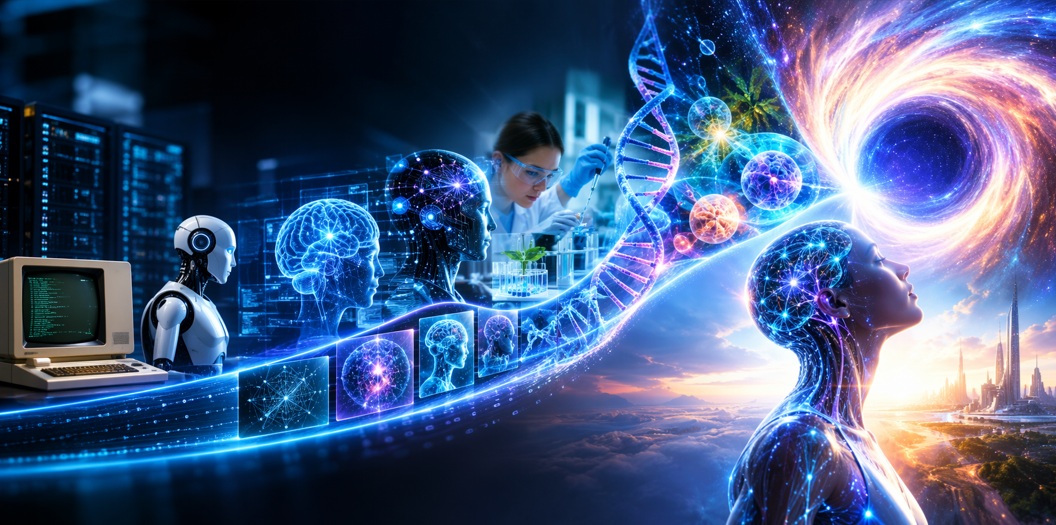
On 29 October 2026, Elon Musk quote-posted a viral biotech thread and wrote:
If you look closely enough, breakthroughs in everything are accelerating exponentially.
An exponential always starts off looking small.
Primary post: https://x.com/elonmusk/status/2115640651517939785.
The line is short. The claim is large: not only AI, but “everything”—medicine, biology, tools—riding curves that look flat until they do not. Online, that language collapses quickly into one word: singularity. EGOD.SI separates three layers: what Musk said, what the quoted thread listed, and what “singularity” does and does not prove.
The viral context: bio/acc and a stack of headlines
Musk was amplifying a post by @m_goes_distance that framed recent biomedical news as a vertical turn: gene editing, metabolic drugs, cancer and immunotherapy results, an AI-designed drug entering late-stage trials, xenotransplant milestones, and the provocative line that the human body is becoming a “software problem” with a shorter update cycle. The thread is advocacy and curation—bio/acc rhetoric—not a single peer-reviewed meta-study. Several items point to real press releases and trial reports; each still needs independent clinical reading, replication, and regulatory context.
Documented: Musk publicly endorsed the pattern of accelerating breakthroughs across domains.
Not established by the quote alone: that every listed result will translate into durable population-level change, or that biology is now literally software.
What “exponential” means—and why it fools the eye
An exponential curve spends a long time near the floor. Early doublings look like noise. Then the same percentage growth produces shocking absolute jumps. Technology writers have used that geometry for decades about computing; Musk’s post generalizes it to “everything.”
Two cautions keep the claim honest:
- Selection: viral lists highlight hits. Failures, stalled trials, and side effects travel less far.
- Domain coupling: AI can speed drug design and materials research; energy, manufacturing, regulation, and human institutions do not automatically double on the same clock.
Acceleration can be real in several stacks at once without every stack sharing one master curve.
Singularity language: event horizon, early stage, gentle takeoff
In technology culture, the singularity usually means a threshold after which machine intelligence (and the systems it redesigns) changes society faster than prior institutions can model. Related phrases in the same ecosystem include:
- Musk’s earlier line that we are on the event horizon of the singularity (February 2025 and later restatements)—a physics metaphor for a hard-to-reverse threshold.
- Public agreement, in other 2025–2026 moments, that we may be in the early stages of a singularity-like transition.
- Parallel industry language (including Sam Altman’s “gentle singularity” framing) that wonders become routine, then table stakes.
None of these slogans is a laboratory measurement. They are judgments about pace and unpredictability. EGOD.SI’s civilizational article already holds singularity talk next to Rome and Golden Age rhetoric—as a frame about who authors the future, not as proof that a secret empire has arrived.
AI, biotech, and “everything”
The October 2026 exchange matters because it joins two acceleration stories:
- Digital intelligence — models, agents, robots, and the compute buildout (Colossus-scale infrastructure, competing “Stargate”-class projects) that EGOD.SI maps elsewhere.
- Biological intervention — editing, vaccines, metabolic drugs, organ technologies—tools that act on the body as if modules can be patched.
When both narratives run hot, culture reaches for one mythic noun. “Singularity” becomes a bag for stock markets, lab results, chatbot demos, and end-times anxiety. Careful writing unpacks the bag.
How EGOD.SI keeps the frames distinct
- Engineering fact: some capability curves in AI and parts of biotech are steep; primary sources and trial data still matter item by item.
- Musk’s claim: breakthroughs in many fields are accelerating exponentially; early phases look small.
- Singularity hypothesis: a near-term phase change in controllable prediction—possible, contested, not identical with any one product launch.
- Theological / anthropological brake (other EGOD.SI essays): acceleration inside creation is not the same as the intelligence or authority of God; “upgrade the body like software” can rhyme with seized transcendence rather than restoration.
Daniel-style readings of “knowledge shall increase” appear in replies under Musk’s post. They are faith interpretations of history’s tempo—not a substitute for checking a phase-3 protocol.
What this article claims—and does not claim
- Documented: Musk’s 29 Oct 2026 exponential post; the amplified bio/acc list; prior Musk singularity / event-horizon language; broad industry talk of early or gentle singularity.
- Reasonable: multi-domain acceleration is a serious public theme in 2025–2026, not only an AI meme.
- Not claimed: that the singularity is complete; that every biotech headline is durable; that exponential growth is unbounded in all variables; or that EGOD.SI predicts dates.
Conclusion
Look closely, Musk says, and the small early segment of the exponential is already behind us in more than one field. That may be true enough to reorder capital, medicine, and military advantage. It is not, by itself, the final word on meaning, free will, or who may rewrite the creature.
Acceleration is a measured shape. Singularity is a disputed threshold. Wisdom is refusing to confuse the curve with the Creator—or the press release with the end of the story.
Editorial note: Cross-reference Golden Age / Rome / singularity (civilizational frame), Colossus and Stargate infrastructure pieces, Genesis vs simulation, and free will / zero day. Biotech claims in viral threads should be checked against primary trial registries and regulators before being treated as settled fact.