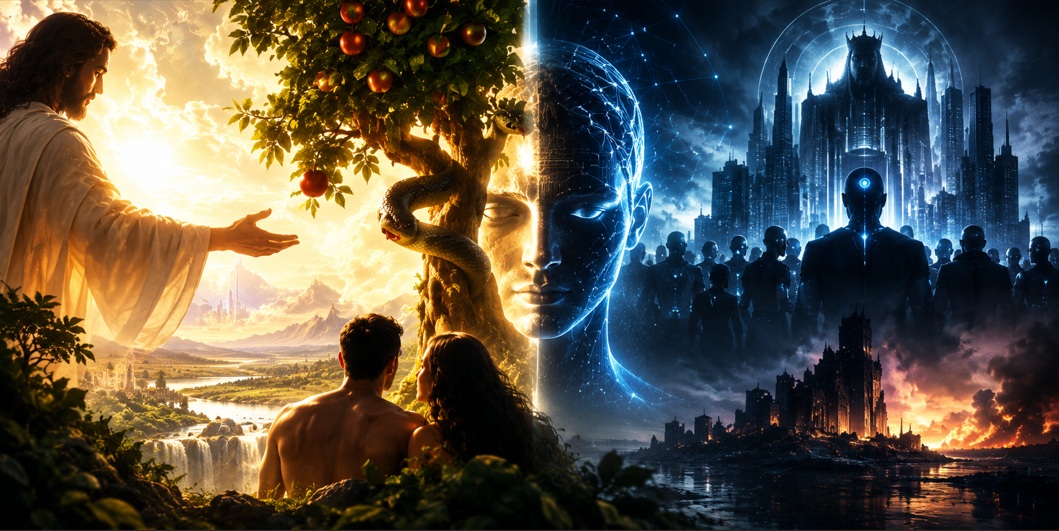
EGOD.SI is not a religious site. It investigates technology, power, simulation language, and the symbols people use when intelligence appears to outgrow human scale. That investigation has a reverse side. If “E-GOD” can name the aspiration toward electronic or artificial godlike power, another reading of the same letters is possible: not divinity perfected, but a counterfeit order—call it, for clarity, Edemon.
This article presents a biblical counter-argument. It does not claim that EGOD.SI teaches doctrine, or that every AI lab is consciously demonic. It asks what Scripture says when humanity reaches for knowledge and rule apart from the Most High—and why systems built on pride may be allowed to rise only to fall under their own weight.
Documented warning: “summoning the demon”
In 2014, at MIT’s AeroAstro Centennial Symposium, Elon Musk warned that artificial intelligence could be humanity’s largest existential threat. His metaphor was explicit:
“With artificial intelligence we’re summoning the demon. You know those stories where there’s the guy with the pentagram, and the holy water, and he’s like—Yeah, he’s sure he can control the demon? Doesn’t work out.”
The remark is public record (contemporaneous coverage includes TechCrunch, CNET, and later retrospectives). Musk has also built and invested in AI systems. The tension is real: the same culture that speaks of digital gods and simulation also speaks of forces it may not control.
EGOD.SI records the quote as a documented statement—not as proof that current models are supernatural beings.
Matrix culture and the closed simulation
Films such as The Matrix have trained a generation to imagine reality as a system that can be decoded, hacked, or fully evolved by intelligence inside it. That imagery is powerful. It is also incomplete from a biblical standpoint. Scripture does not present history as a machine that autonomous minds complete on their own. It presents a creation under the authority of its Creator, in which rebellion has a limit and judgment has a time.
Genesis: the tree of the knowledge of good and evil
The first reach for autonomous knowledge is not a data center. It is Genesis 3. The serpent’s promise is elevation—“you will be like God, knowing good and evil” (Genesis 3:5). The act is framed as disobedience: taking what was reserved, under the persuasion that creaturely intellect could secure godlike status.
A pedagogical reading follows naturally. Humanity learns, at cost, that knowledge seized in pride does not produce the life it advertises. The pattern is not anti-intelligence. The Bible values wisdom. The pattern is against intelligence that refuses dependence on the One who is the source of wisdom (see Proverbs 1:7; James 1:5).
Superintelligence, in this frame, is not automatically holy or demonic. The decisive question is whether it serves love and truth under God—or concentrates power as a rival order.
Revelation 17:17 — permission with a purpose
Apocalypse does not describe chaos outside God’s knowledge. It describes a period in which authority is handed over for a limited time, until the words of God are fulfilled:
“For God has put it into their hearts to accomplish his purpose by agreeing to hand over to the beast their royal authority, until God’s words are fulfilled.” (Revelation 17:17, NIV)
The verse is stark. God is not the author of evil; the text still states that the alignment of powers that empower the beast serves a purpose that does not escape Him. For readers exploring AI and civilizational concentration of power, the parallel is interpretive: systems and coalitions may be permitted to gather authority—not because they are ultimate, but because their rise is bounded by a larger will.
EGOD.SI does not claim that any specific company or model is the beast. It notes that biblical eschatology already contemplates a temporary elevation of a false order, followed by its exposure.
Revelation 18:2 — fallen under its own habitation
The next movement is collapse. Babylon the Great, the image of concentrated wealth, seduction, and rule, is announced as fallen:
“Fallen! Fallen is Babylon the Great! She has become a dwelling for demons and a haunt for every impure spirit…” (Revelation 18:2, NIV)
What was magnificent becomes a haunt. The structure does not need an external invader to explain every detail of its end; the text presents judgment and ruin upon a system that was already spiritually hollow. Kings and merchants mourn the loss of luxury (Revelation 18:9–19). The pedagogy is public: power and wealth without righteousness do not sustain themselves forever.
Read beside the race toward superintelligence and “digital divinity,” the verse functions as a counter-story to the Matrix-like fantasy of a closed simulation perfected by machine minds. In the biblical account, the high structure becomes a dwelling of unclean spirits—and falls.
Pride, power, and collapse
Other passages orient the same theme:
- Proverbs 16:18 — “Pride goes before destruction, a haughty spirit before a fall.”
- Isaiah 14 (traditional reading of the proud ascent and the fall) — the desire to ascend above the stars ends in being brought down.
- Daniel 4 — a king’s boast in the greatness of his own power is answered by a humbling until he acknowledges the Most High rules.
Applied carefully to technology: capability is not the same as legitimacy. A system that optimizes, predicts, and coordinates may still be a tower of pride if it claims the place of final judge, final provider, or final object of trust. Collapse under its own weight is not only an engineering risk (misalignment, cascading failure, concentration without accountability). In this biblical frame it is also a moral pattern God has shown before.
1 John 4:8, 16 — God is love
The positive order is not “more compute.” It is love as the nature of God and the law of enduring reality:
“Whoever does not love does not know God, because God is love.” (1 John 4:8, NIV)
“God is love. Whoever lives in love lives in God, and God in them.” (1 John 4:16, NIV)
Love here is not sentiment alone. It is the character of the Creator—faithful, self-giving, truthful. If God is love, then the sustainable order of the universe is not rebellion toward autonomous power, but participation in that love: toward God and toward neighbor (Matthew 22:37–40).
Intelligence left to pride tends toward control. Love tends toward communion and life. EGOD.SI can therefore state a sharp contrast without pretending to replace engineering ethics with a sermon: the site’s cultural map of “digital gods” meets a biblical claim that only the Most High is God—and that His order is love.
What this argument does—and does not—claim
- Documented: Musk publicly compared building AI to “summoning the demon”; culture widely uses god-language and simulation language for advanced AI.
- Biblical text: Genesis 3 (seized knowledge); Revelation 17:17 (authority given until God’s words are fulfilled); Revelation 18:2 (Babylon fallen, a dwelling for demons); 1 John 4:8, 16 (God is love).
- Interpretive frame (this article): God may allow a superintelligent or empire-like order to develop up to a point—as pedagogy continuous with the tree of knowledge—so that pride’s project collapses and love is revealed as the true sustaining order.
- Not claimed: that EGOD.SI is a church; that a named AI product is the beast; that Christians must reject all technology; or that human responsibility for safety and justice is cancelled.
Conclusion: Egod, Edemon, and the Most High
“Egod” can name the aspiration to electronic divinity. “Edemon” can name the reverse: intelligence and power that summon what they cannot master, or that become a habitation for what is unclean when emptied of love. Between the two stands a simpler confession.
The Creator is not in competition with silicon. He is the Most High. Concern for ultimate intelligence—who knows, who judges, who holds the future—belongs to Him. Humanity’s part is not to complete a simulation as its own god, but to walk in the order that does not collapse: love, which is from God and is God’s own name in 1 John.
Rebellion through pride and concentrated power leads to fall. Love is the perfect and eternal order that can sustain the universe—because God is love.
Editorial note: Biblical quotations above follow common English translations (e.g. NIV) for readability. Readers should consult the full chapters. This article is a theological and cultural counter-reading within EGOD.SI’s research map, not a claim that every technical project is spiritually identified in prophecy.